
Targeted Soft-Tissue Therapy as Part of a Larger Plan
A muscle that always feels tight.
A tendon that hurts every time you run.
A shoulder that reaches the same painful spot.
An old strain that improves, then returns as soon as you increase activity.
These problems are often described simply as “tight muscles” or “scar tissue.”
Sometimes the problem is more complicated.
Muscle, tendon, fascia, ligament, peripheral nerve, joint function and the way an area is being loaded can all influence pain and movement.
At OhioChiro, soft-tissue treatment begins by determining what appears to be involved and why it is being irritated.
Active Release Techniques® — commonly called ART® — is one of the hands-on tools we may use when the examination suggests that soft tissue is contributing to the problem.
It is not the entire treatment plan.
It is one part of a larger process built around diagnosis, movement and progressively restoring physical capacity.
Active Release Techniques® is a proprietary, movement-based system of soft-tissue evaluation and manual treatment.
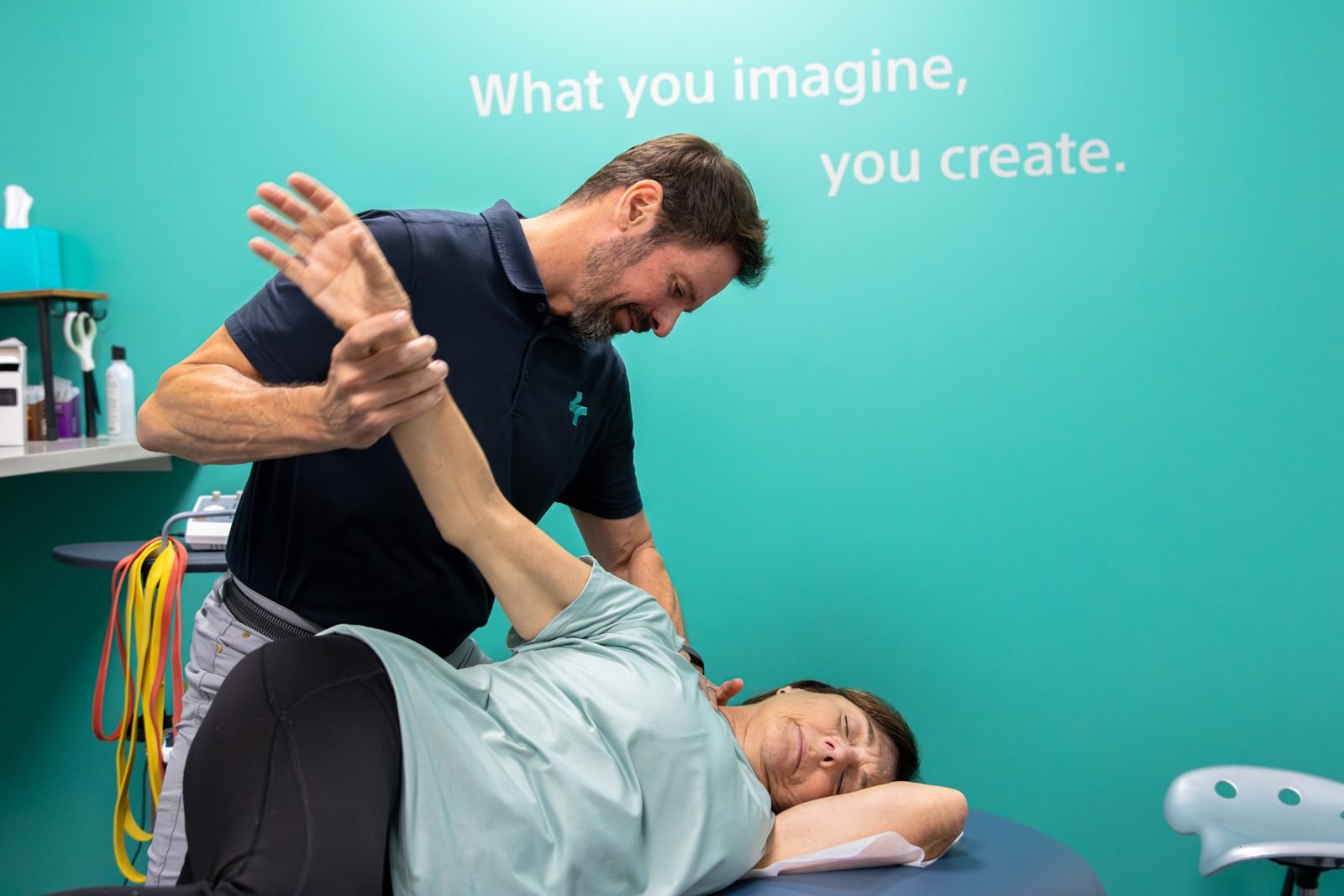
During treatment, the clinician applies precise manual contact to a specific tissue while the patient moves through a controlled range of motion.
Depending on the problem, treatment may involve structures such as:
muscles
tendons
fascia
ligaments
peripheral nerves and the tissues surrounding them
Unlike a general massage, ART is focused on a specific clinical finding.
The provider identifies the structure being treated, applies a targeted contact and uses movement to assess and treat how that tissue is behaving.
The goal is not simply to make an area feel looser.
The goal is to improve comfortable movement and function so that you can progressively return to the activities that matter to you.
ART and other forms of targeted soft-tissue treatment may be considered when symptoms involve muscle, tendon, fascia or certain nerve-related structures.
Common examples include:
Hamstring, calf, hip, shoulder and other muscle injuries may leave an area painful, restricted or difficult to load as activity resumes.
Repetitive loading can contribute to symptoms around the shoulder, elbow, wrist, hip, knee, Achilles tendon and other regions.
Soft-tissue treatment may help restore comfortable motion during rehabilitation while strength and sport-specific capacity are progressively rebuilt.
Learn more: Sports Injury Rehabilitation & Return to Sport
Work, training, gripping, lifting and repeated movement can contribute to symptoms in the forearm, shoulder, neck and other regions.
Manual treatment may be useful when a soft-tissue component appears to be limiting comfortable motion.
Peripheral nerves move through and around muscles, connective tissue and other structures. When appropriate, treatment may include soft-tissue and neurodynamic strategies directed toward those interfaces.
These conditions do not automatically mean ART is appropriate.
The diagnosis comes first.
Pain does not tell us by itself which tissue is responsible.
Shoulder pain could involve a tendon, muscle, joint, cervical nerve or some combination.
Pain in the back of the thigh could represent a hamstring problem, referred pain from the spine or irritation of neural tissue.
Forearm pain could involve muscle overload, a tendon problem or peripheral nerve irritation.
That is why OhioChiro does not begin with:
“Where should we do ART?”
We begin with:
“What appears to be producing your symptoms?”
That distinction matters.
Your visit begins with your history.
We want to understand:
how the problem started
which activities aggravate it
what makes it better
what treatment you have already tried
what you are trying to return to
Depending on the problem, the examination may include:
pain location and symptom behavior
tissue tenderness
active and passive range of motion
strength
tendon loading
joint function
neurologic function
nerve mobility when appropriate
movement quality
gait or sport-specific movement
previous injury
workload and recent changes in activity
functional limitations important to you
OhioChiro may also incorporate 3D Movement Mapping with LiDAR technology to document relevant movement patterns and follow functional change over time.
If the examination suggests that soft tissue is contributing to the problem, ART may be used during the visit.
The clinician applies a specific manual contact while you actively move through a controlled range.
After treatment, the area can be reassessed.
We may look at whether:
movement feels different
range has changed
symptoms have changed
the tissue tolerates loading differently
you can perform the relevant movement more comfortably
That response helps determine what comes next.
First we determine what appears to be involved and whether conservative care is appropriate.
That may require evaluating the spine, joints, muscles, tendons, nervous system and movement patterns rather than focusing only on the place that hurts.
When examination findings suggest that soft tissue is contributing to the problem, ART may be incorporated to address the specific area.
Treatment is targeted.
We do not perform the same routine on every patient or every painful body part.
We assess the response to treatment rather than assuming that more manual treatment is always better.
Manual treatment may help create an opportunity to move better.
Exercise helps develop the ability to keep moving better.
Depending on the diagnosis, treatment may progress into mobility work, therapeutic exercise, strengthening, balance, movement retraining or progressive tissue loading.
For patients who require more structured rehabilitation, OhioChiro can progress care into TASC — Therapeutic Application of Strength & Capacity.
Athletes may progress through our Sports Injury Rehabilitation & Return to Sport model.
Patients who want to continue building strength after rehabilitation can transition into LifeFit.
The goal is not long-term dependence on manual treatment.
The goal is greater physical capacity and confidence.
Dr. Sean Caine’s postgraduate training has focused extensively on the intersection of manual treatment, diagnosis and rehabilitation.
His training includes:
full-body Active Release Techniques® certification
Diplomate, American Chiropractic Rehabilitation Board — DACRB
Manual Therapy and Rehabilitation training through Charles University in Prague
Dynamic Neuromuscular Stabilization
neurodynamic assessment and treatment
Mechanical Diagnosis and Therapy coursework
more than 20 years of conservative musculoskeletal and spine-care experience
That background influences how ART is used at OhioChiro.
The objective is not to find as many tissues as possible to treat.
It is to determine what appears clinically relevant, treat it when appropriate and then move the patient forward.
Research specifically evaluating ART is smaller than the evidence base for broader exercise and rehabilitation approaches.
A systematic review published in the Journal of Sport Rehabilitation evaluated nine studies using ART for musculoskeletal conditions.
The review found evidence suggesting that ART may improve:
pain
range of motion
disability
The authors also emphasized that more research is needed to determine optimal treatment dosage and long-term effects.
That distinction is important.
ART may be a useful clinical tool.
It should not be presented as a guaranteed cure, nor should manual treatment replace the progressive activity and exercise needed to restore physical capacity.
At OhioChiro, ART is therefore used when appropriate within an active treatment strategy rather than as a stand-alone solution.
There is an important difference between making something temporarily feel better and preparing it to tolerate life again.
A painful tendon eventually needs to tolerate load.
A strained muscle needs to produce force again.
An athlete eventually needs speed, power and endurance.
Someone whose shoulder hurts reaching overhead eventually needs to reach overhead.
Someone whose back tightens after sitting may need more than repeated treatment of the muscles that feel tight.
Manual treatment can be useful during that process.
But the destination is movement.
That is why OhioChiro combines hands-on treatment with education, self-care, therapeutic exercise and progressive strength.
Movement as Medicine.
ART has long been used with active people and athletes because sport places significant demands on muscles, tendons and other soft tissues.
But getting an athlete out of pain is not the same as making the athlete ready to play.
When ART is incorporated into sports rehabilitation at OhioChiro, it supports a larger process that may include:
restoring comfortable movement
progressive tissue loading
strength development
running or jumping progression
speed and change-of-direction work
sport-specific movement
tolerance to fatigue
return-to-sport testing
Manual treatment supports rehabilitation.
It does not replace it.
Learn more: Sports Injury Rehabilitation & Return to Sport
Not every painful or tight muscle around the spine is the primary problem.
Back pain may involve joints, discs, nerves, muscles, loading tolerance, movement behavior or several factors together.
When soft-tissue findings appear relevant, ART may be included as part of care.
When another structure or mechanism appears more important, treatment should be directed by that diagnosis.
Learn more: Persistent & Recurrent Back Pain Care
Not every case of leg pain is simply a “tight piriformis” or muscle problem.
Radiating leg pain, numbness, tingling or weakness can sometimes originate from irritation of a spinal nerve root.
Those cases require appropriate neurologic and spine evaluation.
When soft-tissue or peripheral nerve interfaces appear relevant, manual treatment may be one component of care.
When lumbar radiculopathy or another spine condition is responsible, treatment should be directed by that diagnosis.
Learn more: Sciatica & Lumbar Radiculopathy Care
No.
ART is a focused clinical manual-treatment system that combines specific practitioner contact with patient movement.
It is directed toward an identified tissue or functional problem rather than relaxation or general muscle treatment.
OhioChiro uses ART as part of clinical musculoskeletal care.
It is not a massage service.
ART treatment can sometimes feel uncomfortable because the clinician is working directly with a symptomatic or sensitive tissue while it moves.
Treatment should remain tolerable.
Some temporary post-treatment soreness can occur, similar to the soreness experienced after exercise.
There is no universal number.
The answer depends on the diagnosis, duration of the problem, tissue involved, activity demands and response to care.
At OhioChiro, progress is based on your clinical response rather than a predetermined ART treatment count.
ART is frequently described in terms of adhesions or restricted soft tissue.
Human tissue biology is more complex than physically “breaking up” scar tissue with the hands.
Clinically, the more useful question is whether manual treatment improves symptoms or comfortable movement enough to help the patient progress into the activity and loading needed for recovery.
It depends on what is causing the symptoms.
ART may be useful when relevant soft-tissue or peripheral nerve interfaces are involved, but OhioChiro does not assume that radiating leg pain is simply a muscle problem.
Appropriate neurologic and spine assessment comes first.
It may be useful for selected soft-tissue problems as part of sports rehabilitation.
The important question is what happens after symptoms improve.
Athletes still need appropriate strength, power, speed, endurance and sport-specific capacity before returning fully to competition.
If the same muscle always feels tight, repeatedly treating the tightness may not answer the more important question:
Why does it keep happening?
OhioChiro combines diagnosis, targeted manual treatment and active rehabilitation to help answer that question.
ART can be a useful tool in that process.
But the bigger objective is restoring your ability to move, work, train and live with confidence.
Schedule a musculoskeletal evaluation with OhioChiro in Columbus / Upper Arlington.
Last medically reviewed: November 2026
Educational information does not replace an individual examination or medical diagnosis.
Upper Arlington – 3380 Tremont Rd, Suite 190, Upper Arlington, OH 43221
(e) info@visitohiochiro.com
(p) 614-964-2341
(text) 614-964-2341
