
Leg Pain Is a Symptom. Finding Out Why It Is Happening Comes First.
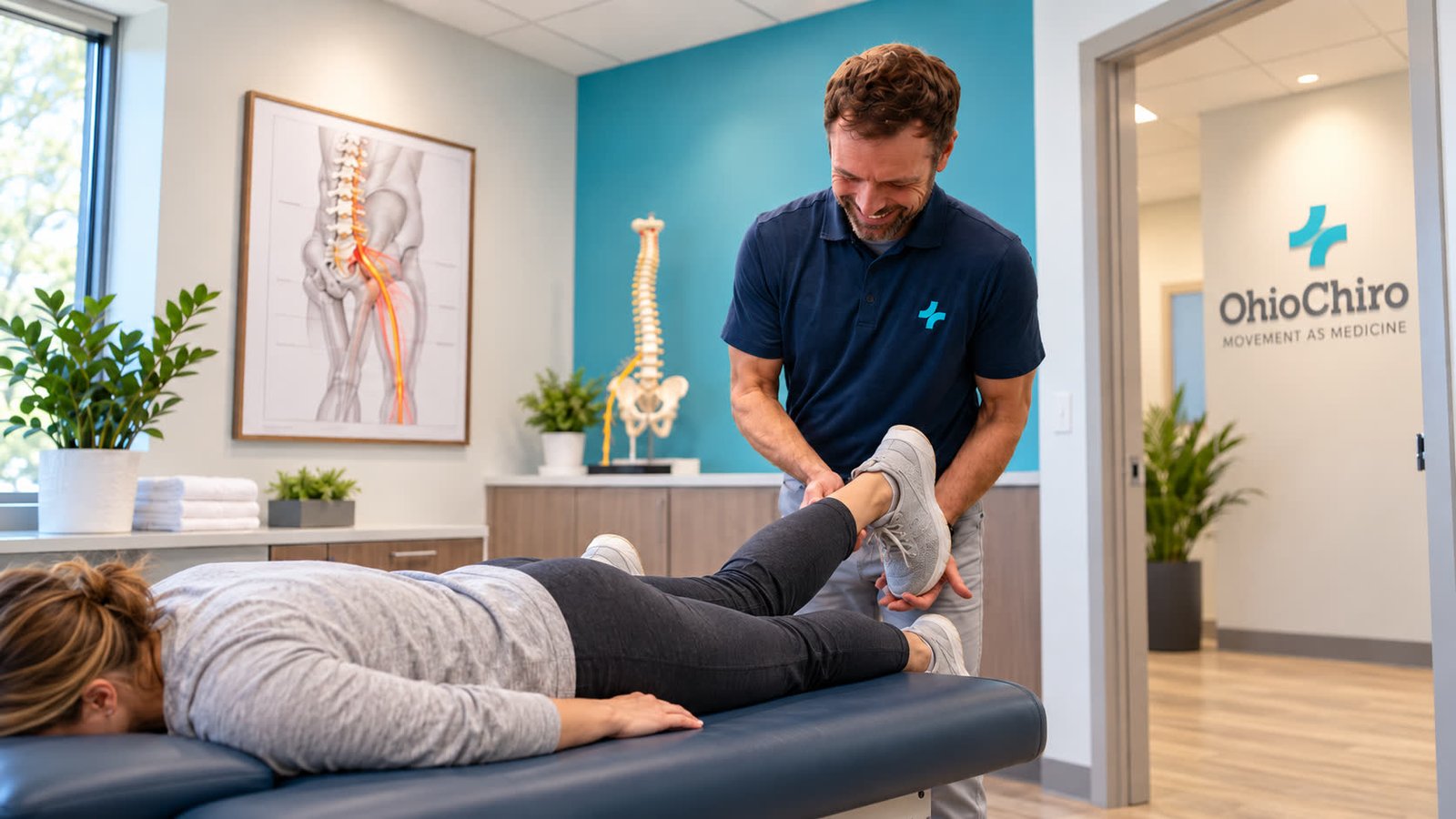
Burning pain down the leg. Numbness or tingling. Pain that gets worse sitting, standing or bending. Sometimes weakness.
People often call all of these symptoms “sciatica.”
Sciatica describes pain traveling along the pathway of the sciatic nerve, but it does not tell us exactly why the symptoms are occurring. Lumbar radiculopathy is a more specific clinical condition in which a nerve root in the lower back becomes irritated or compressed and may produce pain, altered sensation, weakness or changes in reflexes.
That distinction matters.
At OhioChiro, we do not begin by assuming every case of leg pain is the same—or that every patient with sciatica needs the same treatment.
We begin with a diagnosis.
Several conditions can produce back-related leg symptoms, including a lumbar disc injury, degenerative changes around a nerve root, spinal stenosis or inflammation and mechanical irritation of neural tissue.
Other hip, pelvic, muscular and peripheral nerve conditions can sometimes imitate sciatica.
That is why the location of pain alone is not enough to determine what is wrong.
A good examination asks a different question:
What structure or system appears to be producing the symptoms, and how is it affecting the way you move and function?
Your evaluation begins with a detailed history and physical examination.
When appropriate, we evaluate:
OhioChiro also uses 3D Movement Mapping with LiDAR technology to objectively examine movement and track functional progress. The technology complements the clinical examination; it does not replace neurologic testing or clinical judgment. OhioChiro’s existing care model already combines medical assessment with movement assessment and individualized rehabilitation.
Not automatically.
Major clinical guidelines recommend against routine imaging for uncomplicated low back pain with or without sciatica. Imaging becomes more useful when the result is likely to change treatment, when significant or progressive neurologic deficits are present, when serious pathology is suspected, or when symptoms fail to progress as expected.
When imaging is clinically indicated, Dr. Sean Caine can coordinate appropriate imaging and interpret those findings within the context of your examination, symptoms and function.
The goal is not simply to find something abnormal on an MRI.
The goal is to determine what findings actually matter to you.
Most patients who are appropriate for conservative care benefit from staying active and gradually restoring comfortable movement rather than simply waiting for the symptoms to disappear.
Depending on the diagnosis and response to care, treatment may combine:
Understanding which activities are safe, what temporarily aggravates symptoms and how to keep moving without repeatedly provoking the nerve.
Exercise may include trunk strengthening, movement-control training, directional or repeated movements, progressive walking and other exercises selected according to the examination.
Joint mobilization or manipulation and soft-tissue treatment may help reduce pain or improve movement for selected patients, but at OhioChiro these techniques are used to support active rehabilitation—not replace it.
When appropriate, carefully dosed neurodynamic techniques may be incorporated as one part of a larger treatment plan.
Clinical guidelines support exercise-centered care for back pain with leg symptoms and allow manual therapy as part of a treatment package that includes exercise.
Reducing leg pain is important.
But that is not the finish line.
Once symptoms stabilize, the next question becomes:
Can your spine and body tolerate the things you actually want to do?
For patients who need more rehabilitation, OhioChiro’s TASC program progresses from symptom stabilization toward mobility, strength, control and physical capacity.
For those who want to continue building long-term strength after rehabilitation, LifeFit provides a structured pathway beyond recovery.
The objective is confidence—not dependence on treatment.
Some symptoms should not wait for a routine appointment.
Seek urgent medical evaluation for symptoms such as:
Other findings such as a history of cancer, unexplained weight loss or symptoms inconsistent with a typical mechanical presentation may also require additional investigation.
Recognizing when conservative treatment is appropriate—and when it is not—is an essential part of good spine care.
Dr. Sean Caine has more than 20 years of experience in conservative spine care and rehabilitation and holds a Diplomate in Chiropractic Rehabilitation (DACRB). His postgraduate training also includes Manual Therapy and Rehabilitation at Charles University in Prague, Dynamic Neuromuscular Stabilization, Mechanical Diagnosis and Therapy training, Active Release Techniques and neurodynamic assessment.
OhioChiro combines that clinical experience with an integrated clinic-fitness model built around a simple principle:
Movement as Medicine.
Our goal is to help you understand what is happening, determine whether conservative care is appropriate, reduce the interference pain is creating in your life and progressively rebuild your ability to move.
No. Disc-related nerve-root irritation is one possible cause, but spinal stenosis, degenerative changes and other conditions can also produce similar symptoms. Some hip or peripheral nerve conditions can imitate sciatica as well.
Manual therapy can be one part of conservative management for selected patients. OhioChiro does not treat sciatica with manipulation alone. Care is based on the diagnosis and may combine education, exercise, manual treatment and progressive rehabilitation. NICE specifically recommends manual therapy only as part of a treatment package that includes exercise.
Usually not completely. Appropriate activity is generally encouraged, although the type, intensity and range may need to be modified temporarily. Your examination helps determine what activities are appropriate for you.
Surgical evaluation may become appropriate when progressive neurologic loss is present or when significant sciatica persists despite appropriate nonsurgical management and imaging findings correspond with the symptoms.
If pain, numbness, tingling or weakness is traveling from your back or hip into your leg, the first step is not another random stretch or treatment.
It is understanding what is happening.
Schedule a spine evaluation with OhioChiro in Upper Arlington.
Clinically reviewed by Sean Caine, DC, DACRB
Clinical Director, OhioChiro
More than 20 years of conservative musculoskeletal and spine-care experience. Diplomate, American Chiropractic Rehabilitation Board. Certificate in Manual Therapy and Rehabilitation, Charles University–Prague.
Last medically reviewed: October 2026
Educational information does not replace an individual examination or medical diagnosis.
Upper Arlington – 3380 Tremont Rd, Suite 190, Upper Arlington, OH 43221
(e) info@visitohiochiro.com
(p) 614-964-2341
(text) 614-964-2341
